While most brands still treat social media as a single channel, with the same piece running for every country and language, MrBeast, the most watched creator on the planet, has built an entire operation around a simple idea: every region of the world deserves to feel that the content was made for it.
This is not just about translating videos. It is a level of geographic personalization that most media players, and most brands, have not even tested yet.
The same thumbnail, but never quite the same
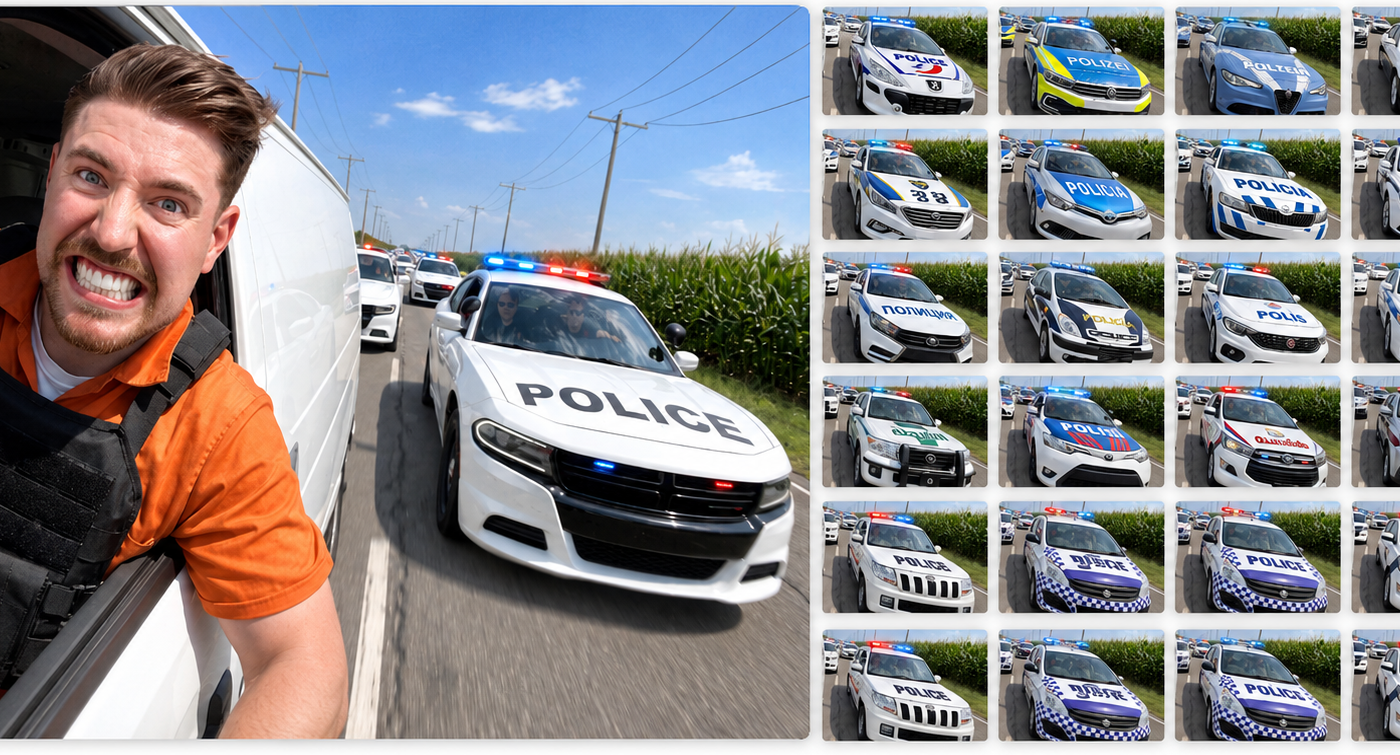
A recent example that circulated online shows the level of detail behind the strategy. In a video where MrBeast appears next to a police car, the thumbnail’s composition is identical worldwide, same pose, same framing, same expression. What changes is the model of the police car in the background, which is swapped for the vehicle design typical of each country. A viewer in Brazil sees one pattern of police car, a viewer in Japan sees another, and so on across dozens of regions.
It is a small detail, but the effect is not small. The brain recognizes the familiar before it even processes the rest of the image. A police car with the colors and design someone has seen on the street since childhood communicates, in under a second, “this is for you too.”
From thumbnails to entire intros, the next level of personalization
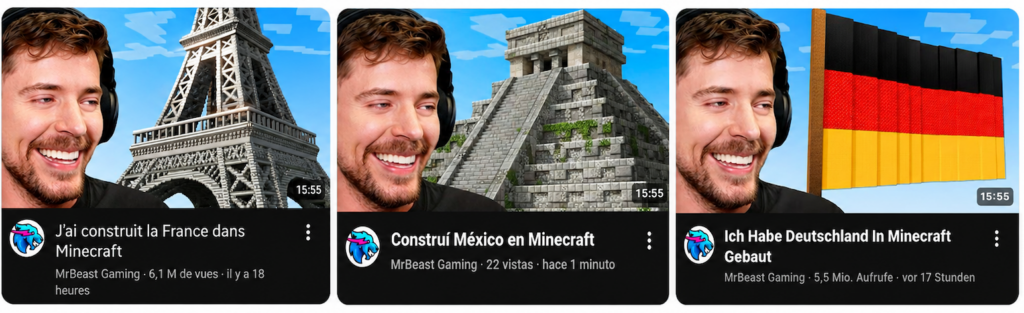
In more recent videos, the strategy went even further. Instead of only changing one visual element in the thumbnail, MrBeast started personalizing the cover image with recognizable landmarks from each region. A Mexican viewer sees a thumbnail featuring Chichén Itzá, for example, even when the video itself is not about Mexico.
The most complete case, however, is the video “I Built New York In Minecraft.” Beyond dedicated thumbnails featuring different regional landmarks, the content of the video itself changes: each dubbed version opens with a different introduction, tailored to the viewer’s country. In the Portuguese version aimed at the Brazilian audience, the dubbed opening is not a literal translation of the English version. It begins by saying “I built Brazil in Minecraft,” even though the original video is about building New York.
This is no longer content localization. It is a rebuild of the opening experience for each market, while keeping the same product underneath.
Why this works: the engine behind the strategy
This layer of personalization was not built overnight. It is the result of a structured investment in professional dubbing that MrBeast began in 2021, when he first tested a Spanish version of his videos. According to reporting by Rest of World, the initial bet was recognizing that 87% of the world does not speak English as a first language, a share of audience that almost no English-language creator was addressing with quality at the time.
The results came quickly. According to data cited by localization platform Phrase, by the first half of 2022 MrBeast’s localized channels had already racked up more than 160 million views combined. Today, his videos are dubbed into more than 11 languages, and his Spanish-language channel has generated as many as 100 million views on a single video, according to YouTube’s own official blog.
YouTube itself confirms this strategy has a measurable effect on the platform as a whole: in internal tests, creators who adopted multi-language audio tracks saw more than 15% of their videos’ watch time come specifically from audiences watching in the non-original language, meaning viewers who likely would never have watched the content without dubbing.
The data shows this is not exclusive to YouTube
What MrBeast is doing with video is, in practice, the most sophisticated version of a behavior that consumer research has been documenting for years across digital marketing as a whole.
A study by CSA Research, surveying nearly 8,700 consumers across 29 countries, found that 76% of people prefer to buy products with information available in their native language, and 40% say they would never buy from a website in another language. Among consumers with no English proficiency at all, that preference rises to 89%. Other industry studies show that digital ads localized by region can perform up to 86% better than generic versions, and that marketing personalization efforts can lift engagement rates by as much as 74%.
The pattern repeats across different sources: it is not translation alone that creates this effect, it is the feeling that a piece of content, an ad, or a video was specifically designed for the reality of whoever is on the other side of the screen.
What brands, clubs, and sponsors can learn from this
MrBeast is not simply translating content to sell to more people, he is delivering an extra layer of dedicated attention to specific communities, something most brands with international operations still treat as a secondary detail, when they treat it at all.
For a brand operating across multiple countries, or one that sponsors competitions and athletes with international audiences, the lesson goes beyond hiring dubbing services. It lies in reviewing every touchpoint, thumbnail, caption, video script, advertising piece, and asking: does this look like it was made for this specific audience, or is it the same piece reused with a translation layered on top? The difference between those two answers is often the difference between being seen and being felt as close.
In a landscape of growing internationalization for brands, clubs, and sports properties, this layer of personalization is likely to stop being a differentiator and start being expected by audiences. Whoever moves first, the way MrBeast did on YouTube, has the chance to build a connection that no generic translation could ever replicate.
If your brand is thinking about expanding into new markets and wants to build a content and media strategy that genuinely speaks to each local audience, get in touch with the End to End team and let’s plan that journey together.